Appearance
人工智能(AI)
2026-05-13 Big tech is sacrificing its cashflows to prop up the AI boom
Amazon, Meta and Microsoft are all expected by analysts to announce negative cashflows in at least one quarter this year. Alphabet, the parent company of Google, will just about keep its head above water. Oracle, the weakest of the bunch, is already drowning.
At around 40% of their revenues this year, the cloud giants’ capital expenditures will surpass those of the oil industry during the shale boom in the 2010s and the telecoms industry during the dotcom bubble in the 1990s.
Total future revenue agreements have risen to $2trn, from $730bn last year, at Amazon, Google, Microsoft and Oracle (Meta is a buyer, rather than a seller, of computing capacity).
Simple balance-sheets with intangible assets and generous cash buffers have been replaced by ones which are complicated, asset-heavy and indebted. Since the start of last year the big five have raised $260bn from bond markets, a quarter of all such borrowing by listed American non-financial firms. What started as a local affair has become a global bacchanal. Nearly a third of the haul from selling bonds this year is in currencies other than the dollar. Alphabet, Google’s parent, will soon issue its first bonds denominated in yen.
“When we ask our lawyers to find ways that a hyperscaler might wriggle away from or re-negotiate a lease contract, often they come back with a very long list,” says the boss of one big lender that has steered clear of some more esoteric financing structures in the AI boom.
The five firms have assumed the role of central planners, attempting to make the complex chain of returns on investment work across the AI economy: data centres are useless if businesses don’t find models worth paying for, which only happens if model-makers can raise enough capital to make them.
Moreover, the hyperscalers’ capex has become someone else’s free cashflow. Broadcom, Micron, Nvidia and Sandisk, four chip companies, are all minting real fortunes outfitting big tech’s data centres. Together they account for a quarter of the expected profit growth in the S&P 500 index this year.
Clearly this is unsustainable without enterprises becoming much more willing to pay for AI. But for now there are no brakes on the train. The hyperscalers’ capex bills this year will be twice as great as analysts predicted they would be a year ago. If AI models keep getting hungrier for computing power and the cost of equipment keeps rising, this forecast will soon be left behind, as those that came before it were. After two years of consistent shock-and-awe, nothing would be less shocking.
2026-04-30 The AI supply crunch is here
2026-04-28 Why DeepSeek’s sequel failed to impress
The release comes at a time when China’s AI scene is increasingly crowded. DeepSeek has faced growing competition both from other independent labs, such as Moonshot and Z.ai, and the country’s internet giants. The Qwen family of models produced by Alibaba, an e-commerce colossus, has sat comfortably atop China’s leader-board for most of the past year. ByteDance, the creator of TikTok, is also the maker of Doubao, China’s most-popular chatbot. Dola, as it is called outside of China, is hugely popular in Mexico, the Philippines and Britain, where it ranks above Google’s Gemini in Apple’s app store.
In China, much of the attention has shifted to the apps built on top of AI. Alibaba puts its Qwen model to use elsewhere in its business, offering a “digital workforce” to merchants using its e-commerce platform, for example. The country’s internet giants are now racing to build AI-powered “super apps” that can facilitate a wide range of digital transactions. Clever models alone are not seen as the way to make money from the technology.
At the same time, DeepSeek has had to contend with greater state meddling. China’s government has been promoting chips made by Huawei, the national semiconductor champion. DeepSeek reportedly tried to train its new model on them, but eventually fell back on Nvidia’s chips instead, adding cost and time. The government seems unlikely to give local AI companies a freer hand any time soon: on April 27th it said that it would block the acquisition of Manus, another of the country’s AI darlings, by Meta, an American social-media giant.
2026-04-16 America wakes up to AI’s dangerous power
2026-03-19 Deploying the technology is the real world is proving tricky
The Nifty it index dropped by around a fifth following a viral blogpost that imagined new artificial-intelligence coding tools would wipe the industry out altogether (see chart).

IT consulting firms such as Infosys and Tata Consultancy Services (tcs) derive much of their revenue by providing customers with armies of Indian coders who perform labour-intensive tasks such as maintaining software, answering support tickets and writing routine code.
But such improvements in productivity are only possible in “greenfield” environments with “clean architecture”, argues Atul Soneja, chief operating officer at Tech Mahindra, an it firm.
Deploying ai in “brownfield” environments—with legacy code, a lack of documentation and multiple systems that must all continue to operate in real time—is far trickier. In the end, clients often realise that their ai dreams were too ambitious and end up hiring as many outsourced coders as before, say executives.
They argue that they can now fulfil more of a strategic role for their clients: getting the most out of ai requires understanding all of the context around the problem, something that consultants with experience across businesses can offer. Nandan Nilekani, one of the founders of Infosys, reckons that such services related to ai could be worth $300bn-400bn by 2030.
From the moment Chatgpt made its debut in November 2022, Indian outsourcers have been pegged as one of the sectors most exposed to displacement by ai. More than three years on, though, the promised disruption has not arrived. Revenues are growing, and hiring continues.
2026-03-18 Is cheap energy the key to China gaining AI supremacy?
Global demand to power such data centres could surge to 68gw by 2027 and 327gw by 2030, say researchers at rand, an American think-tank.
“Many ai projects are now constrained not by chip supply but by…whether enough reliable electricity can reach the building,” says one person at a semiconductor firm.
China has no such worries. Its power grid, the world’s largest, is still growing at a blistering pace thanks to massive state investment. It added over 500gw of capacity just last year, to reach a total capacity of 3,800gw, more than double that of America’s. Over the next five years China is set to add six times as much capacity as its rival. A bonanza of wind and solar projects is driving growth. And half of the world’s nuclear-power plants are also under construction in China, while the country is still building lots of coal-fired power. Chinese data centres can secure power for around three cents per kilowatt-hour, according to official figures, around half the rate many American ones pay. And because the government sets residential power prices separately, there is little risk of public opposition to power-hungry infrastructure.
Last year China’s tech firms were estimated to have spent $24bn on ai infrastructure, such as data centres; American ones spent over $350bn.
Huawei’s homegrown 7nm ai chips are still less powerful than American offerings, but they can close the performance gap when lots are stacked together. That consumes more energy, but it matters less when electricity is cheap. This year China’s leading foundry, Semiconductor Manufacturing International Corporation, which makes most of Huawei’s 7nm chips, plans to double its capacity for making them. In March, Reuters news agency reported that Hua Hong, another Chinese foundry, was also starting to make 7nm chips.
But in October Alibaba became the first big Chinese firm to announce it was pursuing agi. And in March China released its new five-year plan, for the period to 2030. It included a call to “explore development paths for agi”.
2026-03-12 Why investors won’t know what to make of AI for a while
2026-03-12 In praise of grunt work
2026-03-12 Altman, Amodei and Musk fight dirty for the biggest prize in business
Mr Musk has bolted it onto SpaceX, which was already flourishing. Last year it reportedly made an operating profit (before depreciation and amortisation) of $8bn from sales of $15bn-16bn.
2026-03-05 Americans’ electricity bills are up. Don’t blame AI
In the past few years retail electricity prices have indeed outpaced overall inflation (see chart 1)

It fingered grid upgrades and rising costs of power-generating equipment and raw materials such as copper. Wood Mackenzie, a research firm, estimates that last year demand for distribution transformers outstripped supply by 10%. For power transformers the gap was 30%. Manufacturers report waiting lists for essential grid-related kit stretching to 120 weeks or more, up from 50 weeks in 2021.
The Edison Electric Institute, which represents private-sector utilities, predicts its members’ cumulative capital spending will reach $1.1trn between 2025 and 2029, up from $765bn in the previous five years. More than half the sum for distribution and transmission infrastructure will go on replacing ageing equipment and hardening it against extreme weather made likelier by climate change. Between 2019 and 2023 big Californian utilities spent $27bn just on mitigating wildfire risk. These investments have been neglected for years. Now, says an industry bigwig, AI provides a pretext to help win approval from regulators to pass the cost on to consumers.
Microsoft has signed a long-term deal to restart a nuclear reactor at Three Mile Island to supply its data centres.
Meta has backed a handful of nuclear startups.
In December Google’s corporate parent, Alphabet, paid $5bn for Intersect Power, a developer of utility-scale solar power and battery storage. A data centre in Ashburn belonging to Equinix, a big operator, is experimenting with fuel cells.
Besides adding its own supply, big tech is making existing capacity more flexible. Google has agreed to novel tariff arrangements with Indiana Michigan Power, a midwestern utility, whereby its data centres can reduce their consumption when other demand is high.
Microsoft is going further. In one of its Irish data centres it uses backup batteries as a “grid stabiliser” that can push power back into the network or draw excess power from it at times of stress. Since grids often run well below full capacity, adding a large, flexible customer can bring in lots of revenue for utilities without requiring costly expansion. This lets the utilities lower rates for households while preserving their margins.
The Electric Power Research Institute, a think-tank, found that some states with high load growth between 2019 and 2024 reported price declines, after adjusting for inflation (see chart 2). The World Resources Institute, another think-tank, notes that in North Dakota rising demand from oil and gas extraction, cryptocurrency miners, data-centre operators and food-processors led to large price reductions for local electricity users. PG&E, a big Californian utility, estimates that adding a gigawatt of load could lower bills by up to 2%. If Americans want lower electricity bills, they should be shouting for more AI, not less.
2026-02-25 A viral research note on AI gets its economics wrong
In the early 19th century David Ricardo, a financier, and Thomas Malthus, a clergyman, debated the possibility of a “general glut”. Grain prices were falling and industrial output surging, but workers were visibly unemployed. A surge in output was seemingly matched by an absence of spending power. There was too much of everything all at once.
Ricardo thought such a thing impossible. It violated Say’s Law, that “production creates its own demand”. How does a farmer buy textiles? He produces food and swaps it: real output is the income with which to buy something else. Only a “partial glut” was possible. One sector (say software today) might produce so much that its prices collapse and its workers lose jobs, but that should allow another to purchase more. Some people and firms lose and others win, but that is the nature of economic disruption.
Yet economy-wide recessions do happen. Later economists, such as John Maynard Keynes, pointed out that money could get in the way. Production and consumption do not have to be simultaneous: a firm can make something, sell it and then hold on to the cash. A general glut was therefore possible. Perhaps this time the owners of AI companies will simply sit on the cash their bots generate. But that would be deflationary, rather than lead to the surge in nominal GDP Citrini predicts. Unemployment would indeed rise, but GDP would fall.
Is this a plausible future? It doesn’t look that way. If anything AI companies are desperate to redeploy cash to build more data centres, not to hoard it, even though big productivity gains are elusive so far. Many investors worry that ai companies will run out of funding.
And policymakers have tools of stimulus—interest-rate cuts, bond-buying and handouts—with which to fight demand slumps. It is unlikely that an AI take-off would bring about an economy that lacks spending.
2026-02-23 THE 2028 GLOBAL INTELLIGENCE CRISIS
2026-02-19 In defense of vertical software
The value of enterprise software comes from understanding the process and the organization well enough to make the software do exactly the right thing.
But that’s not why Bloomberg is sticky. Bloomberg is sticky because a generation of finance professionals was trained in Bloomberg, they communicate with each other through Bloomberg. There’s an entire economy and world of social norms built around Bloomberg.
That’s a network effect: shared tooling creates a shared language that becomes powerfully self-reinforcing. And that moat doesn’t go away just because migrations become easy.
Better models compounded the abilities of application companies' orchestration layers, because the orchestration layer is where the reliability lives. You can have the most capable model on earth and still produce garbage outputs if you don’t have the scaffolding to constrain, verify, and route that capability through a specific professional workflow. At a certain level of capability, the hard part of getting an AI system to do legal work reliably was never the model. It was the orchestration: figuring out exactly when to trust the model and when to check its work, what data to feed it and in what order, how to format outputs so that they’re usable by people in specific roles at specific firms.
2025 was the year that AI became truly useful for law; I think that 2026 is shaping up to be that year for finance.
Finance is research, drafting, modeling, multimodal analysis — pulling numbers from a PDF and pushing them into a model, out of Word and into PowerPoint and back into Excel, running sensitivity analysis and then formatting the output to the exact specifications of a specific investment committee. It’s multimodal tool use at every step of the process.
An asset manager doesn't need a system that gets things right eighty percent of the time. In finance, 90 percent right is the same as 100 percent wrong.
Every single part has to be reliable, or the whole thing is completely useless.
When the expected value of a correct answer is ten million dollars and the expected cost of a wrong answer is also ten million dollars, financial institutions will pay almost anything for a system that they can actually trust.
2026-02-12 Private-equity barons have a giant AI problem
During the 2010s there were two reliable ways to make a fortune. The first involved selling enterprise software, the countless computer applications which now dominate office life. Businesses subscribe to these applications, as you might a magazine, as opposed to buying them only once, as you would a book. This “recurring” revenue explains the interest of private-equity funds, the second great gold mine of that era. During the past decade buy-out funds spent one in every three dollars on technology firms. As software ate the world, private equity drank champagne.
Central banks fractured this alliance when they raised interest rates in 2022. Now Claude Code threatens to shatter it.
Traders expect customers and startups armed with AI-coding tools like Anthropic’s Claude to beat up incumbent software firms. Marketing tools? Thwack! Legal tech? Crunch! Financial-data providers? Pow! The value of listed software firms has fallen by a fifth this year.
Loans to software firms owned by private equity have tumbled, along with the value of funds that own those loans and the asset managers which run those funds.
TPG admitted that 18% of the money from its buy-out funds was in the software industry.
KKR and Blackstone tannoyed a lucky 7% to the market, calculated across their vast asset-management operations.
Nothing to see here, said Carlyle: 6%. Brookfield went for “less than 1%” and Apollo, which has encouraged the rout by short-selling software loans, crowed that exposure to software in its private-equity funds “rounds to zero”.
The biggest have refashioned themselves, with varying levels of success, as safe, all-weather lenders to every part of the economy, rather than leveraged equity investors beholden to cyclical performance fees.
During the past five years the value of software firms in the S&P 500 index has fallen from 13 to eight times their revenue over the previous 12 months; across all listed American software firms the figure has gone from eight to three times.
Compare that with the 25 largest private-equity buy-outs of traded software firms between 2019 and 2022, for which the median deal was struck at nine times the target firm’s revenue.
More important than the fate of the funds which own software firms is the debt that paid for their deals. Analysts reckon more than $500bn of borrowing tied to software firms is lurking in America’s credit markets.
Buy-out deals were funded primarily by loans, which have floating rates and place more restrictions on the borrower. Perhaps 16% of the leveraged-loan market is tied to software deals, much of it housed in collateralised-loan obligations, an instrument similar to the one that broke financial markets in 2008.
The largest bets on software debt, though, are found in business-development companies (BDCs), a type of corporate-lending fund often run by the biggest private-markets firms.
BDCs come in two types. The majority of assets sit in vehicles that are not publicly listed. Investors can redeem their shares in the fund each quarter. The largest is Blackstone’s BCRED which, were it a standalone bank, would be America’s 34th-biggest. Fully 26% of its loans are to software firms, mainly owned by private-equity funds.
Other BDCs are traded on the stockmarket, which means investors can sell their shares whenever they want. The largest is run by Ares and has invested 24% of its assets in software loans. In recent weeks some investors have panicked. Listed BDCs trade at a growing discount to the value of their assets (net of debts).
Last month investors in an unlisted BDC run by Blue Owl that has at least 29% of its portfolio in software debt pulled 15% of their money out.
Traders mostly rely on a single piece of technology, the Bloomberg terminal, which has proved impervious to efforts by customers and competitors to create their own replacements.
The work of investment bankers and private-equity bosses has been largely immune to changes in office software. They still spend much of their days labouring over Microsoft Excel, just as they did a generation ago.
2026-02-01 Why software stocks are getting pummelled
On January 29th SAP, whose applications are widely used to manage everything from inventory to payroll, said during an earnings call that it expected a “slight deceleration” in its cloud-based software business in 2026. Its share price plummeted by 15%.
That of ServiceNow, whose tools help businesses automate various tasks, dropped by 13%, even though in the latest quarter its revenue grew faster than analysts had expected.
Even software companies that released no news suffered, with Salesforce down by 7% and Workday by 8% (see chart 1).

The carnage reflects growing nervousness over the future of the software industry in the age of artificial intelligence. The value of listed American enterprise-software companies is down by 10% over the past year.
But could an AI upheaval be just around the corner? Pundits have focused on two threats. The first is from AI coding tools. Anthropic’s Claude Code and OpenAI’s Codex, among others, help programmers to write code far more quickly. “Vibe coding” startups, such as Lovable and Base44, allow even laymen to make software by giving chatbots simple instructions. The fear is that these tools are allowing companies to create much of the software they need themselves. The other threat is that AI-native enterprise-software startups—such as Attio, which sells customer-management tools, or Glean, which offers a product that allows companies to perform advanced searches on their internal data—will steal business from the incumbents.
For most companies, building software is a distraction from their core business. The trend for decades has been in the opposite direction.

AI will continue to improve. But it is also likely to get more expensive. At present Silicon Valley heavily subsidises its price. That cannot last for ever. OpenAI expects to burn $17bn in cash this year. Microsoft’s share price took a beating last week as investors winced at its enormous spending on the data centres underpinning the technology. Eventually these companies will need to demonstrate a return on all that investment, which is bound to mean higher prices.
When that happens, dedicated software companies will have an advantage. That is partly for the simple reason that they can spread the cost of developing a program over their many customers. But it is also because they are better at using AI to write code. A recent paper by Fiona Chen and James Stratton of Harvard University examined the productivity of programmers using AI, and found that it resulted in an increase in output (measured by the number of tasks completed) only for those at companies selling software.
What of the software industry’s AI-native rivals? Here, too, the fear of disruption may be overblown. Incumbent software providers have been investing heavily to embed AI features in their products. To speed the effort, they have been on a dealmaking spree. Acquisitions last year included Workday’s purchase of Sana Labs, a Swedish AI startup, and ServiceNow’s purchase of MoveWorks, another AI company. The software giants have deep pockets to fund more investments: together Salesforce, SAP, ServiceNow and Workday generated almost $30bn in free cashflow last year. Their products are also sticky, because it is expensive and risky for large companies to switch software, and the companies can use their scale to quickly gather feedback on new AI features.
Even if the price of accessing AI goes up, the technology should still bring down the cost of developing software over time. That could lead to more, not less, spending on software, as companies use it to replace tasks still done by humans.
A paper published by the Bank of France finds that such spending is reasonably elastic. In our analysis of official data on American business-software investment, we similarly find that a 10% decline in software prices is associated with a 20% rise in spending. Software may eventually eat the world, but so far it has only nibbled around the edges at most companies. It could soon take a much bigger bite.
2026-01-15 Innovations in energy and finance are further inflating the AI bubble
Power suppliers are overwhelmed by demand for electricity to run AI chips in vast data centres. Ercot, Texas’s grid operator, has received requests for more than 226 gigawatts (GW) of power by 2030, nearly 100 times more than it approved in 2022. President Donald Trump has joined a chorus of Americans worried that the insatiable power demand from AI projects will drive up electricity prices. On January 13th he promised citizens they would not “pick up the tab”. Tech giants such as Microsoft would instead.
For a few years before xAI, his model-maker, joined the AI race, tech giants hooked their data centres directly to America’s electricity grid. But the more demand there was, the longer it took to secure a connection—and Mr Musk was in a hurry to catch up with rivals such as OpenAI. So he pioneered what SemiAnalysis, a research firm, christened the “BYO” (bring-your-own) alternative to grid-based energy. When xAI built a big cluster of graphics processing units (GPUs) in a record four months in Tennessee in 2024, it literally trucked in gas turbines and engines. Initially, this was a stopgap measure. But with grid connections now taking as long as five years to secure, BYOs are here to stay.
Last monthBoom, which is building ultra-fast planes, announced that it would supply 29 natural-gas turbines based on the same technology as its jet engines to Crusoe, a data-centre developer. Wärtsilä(WRTBY), a Finnish firm that makes engines for cruise ships, also sells them for data centres. Other promising new technologies such as fuel cells may be harnessed, too. All told, Goldman Sachs reckons that up to a third (or 25GW) of incremental data-centre capacity will be built off-grid in America over the next five years. That will mean data centres can spring up more quickly.
Adjacent to a $20bn fundraising that xAI completed in early January, it will lease $5.4bn-worth of Nvidia GPUs from a special-purpose vehicle (SPV) set up by Valor Equity Partners, its long-standing backer. Both Meta and Oracle have also used SPVs to reduce the strain that data-centre projects are placing on their balance-sheets. Meta whipped up an extraordinary concoction of private capital, corporate bonds and debt guarantees to raise $30bn for a mammoth data centre in Louisiana called Hyperion. Fittingly, the SPV for the project is named after a sugar-coated New Orleans pastry called a beignet. Oracle has also reportedly raised $66bn in off-balance-sheet financing through SPVs, all to support OpenAI, which has so far proved to be far better at making deals than making money.
The size of such deals—as well as their concentration among a small group of borrowers—is giving the heavily regulated banking industry indigestion. It is happy to arrange bond issues for highly profitable hyperscalers. But the less creditworthy the counterparty, the trickier it is to hold loans on a bank’s books for long. This is providing opportunities for private-credit firms, often funded by life insurers, who are either originating loans to data-centre borrowers or buying bespoke tranches of the banks’ AI-loan portfolios. The market is potentially huge. Morgan Stanley reckons that data-centre financing involving private-credit firms will reach $800bn in the five years to 2030—or about half the total amount it expects to be borrowed in the data-centre boom. Yet many of the financiers involved are making it up as they go along.
In the energy markets BYO power brings higher costs and exposes data centres to greater risk of equipment failure than they would otherwise have on the grid.
As for the credit markets, they are a good place to raise money now that AI investment can no longer be entirely self-funded. But the spillovers may also be dangerous. Only a few firms are making reliable profits from AI. If that does not change, there is a risk of a credit meltdown that could rock the financial system and the economy more broadly. Then the world will need a new type of ingenuity—at picking up the pieces.
2026-01-12 Which countries are adopting AI the fastest?
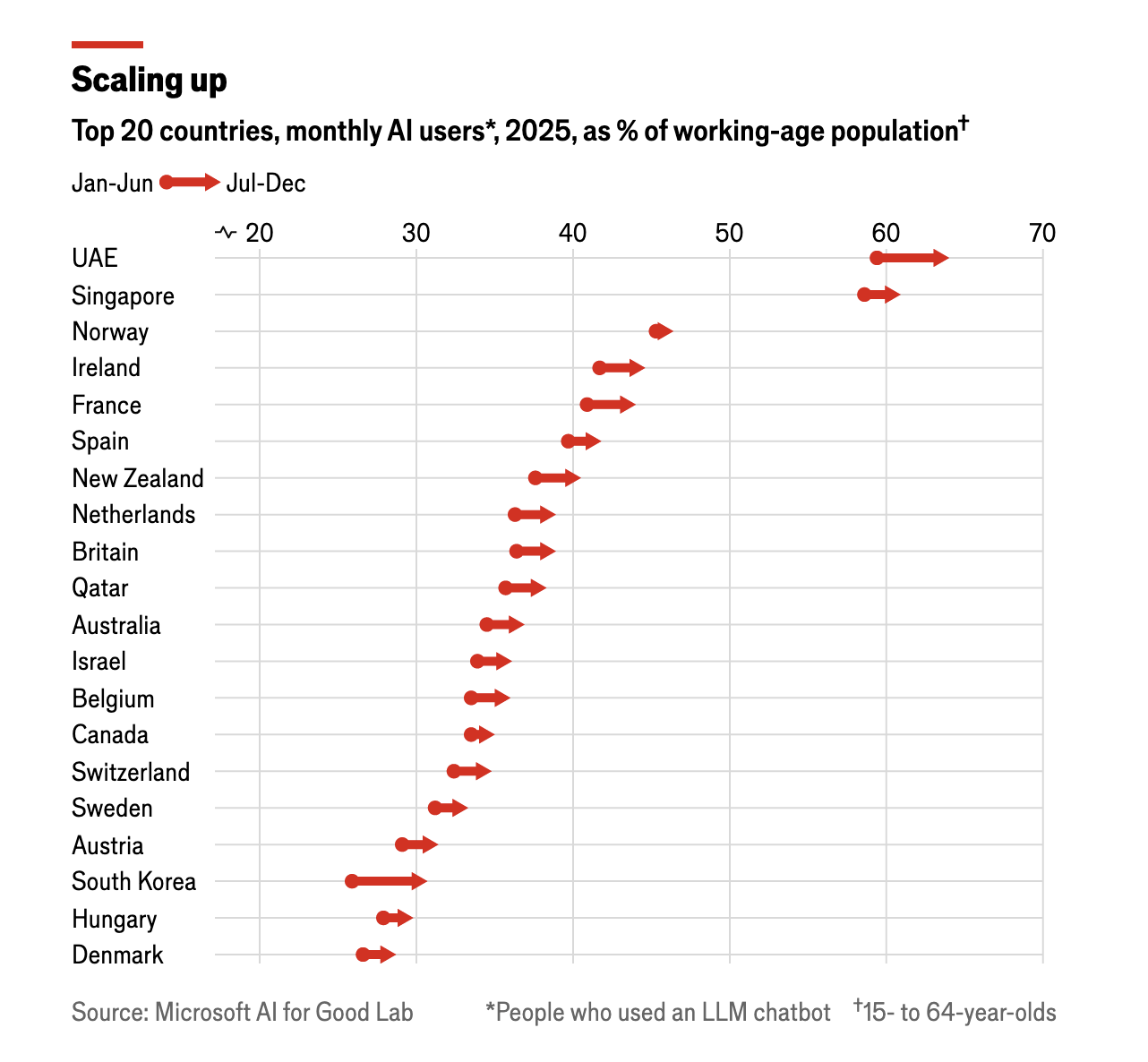
ARTIFICIAL INTELLIGENCE (AI) entered the mass market just three years ago, but by the end of 2025 some 16% of the world’s working-age population used generative-AI tools each month.
America and China lead the world in developing the technology, but they are not the ones adopting it fastest.
Residents of the United Arab Emirates, Singapore, Norway, Ireland and France were the top AI adopters. In both the UAE and Singapore more than 60% of the working-age population used AI chatbots.
South Korea is the fastest-growing market; there the number of working-age users increased by 18.5% from the first to the second half of last year. Viral AI-generated images—photos transformed into Japanese anime-style figures—caught Koreans’ attention, and models’ grasp of their language is fast improving.
People in rich countries tend to use AI chatbots more than those in poor ones do , but GDP per person is an imperfect guide to how quickly a country takes up the technology. America ranks only slightly above the Czech Republic and below Poland, despite being far richer than both. India appears to be adopting AI much faster than incomes there would suggest, while China is slightly below trend. Relative to GDP, people in Jordan and Vietnam are particularly keen users of LLMs.
DeepSeek is especially popular in Africa, where usage per person is between two and four times that of other regions. It also leads in places where American technology is restricted: the countries where DeepSeek has the largest estimated market share are China (89%), Belarus (56%), Cuba (49%), Russia (43%) and Iran (25%).
2026-01-08 AI is transforming the pharma industry for the better
Ai-designed molecules show an 80-90% success rate in early-stage safety trials, compared with a historical average of just 40-65%. It will be years before it becomes clear whether success rates rise in later-stage trials, too. But even if they do not, one model suggests that early-stage improvements alone could increase the success rate across the entire pipeline from 5-10% to 9-18%.
The industry is also wringing efficiencies out of its business using AI, in areas from clinical documentation to HR. McKinsey reckons that if AI is fully utilised by the pharma industry—no doubt with its consultants’ assistance—it could provide a boost worth $60bn-110bn annually.
The technology is already changing how the pharma industry works. A new generation of AI-native biotech startups—particularly in America and China—is emerging. Pharma companies are increasingly forming alliances with AI-biotech firms, as well as with technology giants including Amazon, Google, Microsoft and Nvidia. And those big tech firms have their own ambitions in health. Isomorphic Labs, a spin-out from Google DeepMind, is trying to design entirely new therapeutic molecules from scratch inside a computer. Nvidia, too, has a generative-AI platform for drug discovery. Both firms are signing deals to offer design services to pharma companies. And in October Nvidia teamed up with Eli Lilly, the world’s most valuable drugmaker, to build the pharma industry’s most powerful supercomputer.
All this means that some of the value of drug discovery may be captured by tech giants. For now, pharma firms have many clear advantages, including heaps of data, scientists who know the field and long experience of shepherding new drugs through a maze of regulation. Over time, though, as parts of biology become more of a computational problem that can be solved with technology, such advantages could be eroded. Pharma firms may need to buy in ai expertise in the same way that they buy early-stage assets from biotech firms today.
As drug discovery becomes more efficient, governments will need to turn their attention to other potential bottlenecks in the system, such as regulation and trials. America’s Food and Drug Administration and the European Medicines Agency are themselves starting to use ai to screen the mountains of data they receive. As the number of drug candidates rises, faster regulatory reviews will be needed to avoid a logjam. Governments could also do more to encourage the sharing of patient data with AI companies in privacy-preserving ways so that AI models—and drug discovery—can improve.
Patents, too, will need rethinking. Today, long patent lives let pharma firms recoup the investments they make, encouraging them to undertake the risky business of drug discovery. Yet if the costs and riskiness of innovation fall dramatically, then patent terms (which typically provide 10-15 years of market exclusivity) may need to become shorter. ai brings good news for drug innovation. But to ensure that it benefits both the makers and takers of new drugs, the industry and its regulators will need to adjust to this new reality.
2026-01-07 The “ChatGPT moment” has arrived for manufacturing
According to the International Federation of Robotics (IFR), an industry association, there were around 4.7m industrial robots operational worldwide as of 2024—just 177 for every 10,000 manufacturing workers. Having risen through the 2010s, annual installations surged amid the pandemic-era automation frenzy, but flattened off afterwards, with 542,000 installed in 2024.
That has been mirrored in the wider market for factory-automation equipment, including sensors, actuators and controllers, which has faced tepid demand over the past few years amid a slowdown in manufacturing, particularly in Europe. Despite a stellar performance during the pandemic, shares in the industry’s big suppliers have lagged behind those of other rich-world companies since the beginning of 2024 (see chart 1).
Yet analysts see 2026 as an inflection point. The IFR reckons that annual robot installations will increase to 619,000 this year (see chart 2). Roland Berger, a consultancy, forecasts that inflation-adjusted growth in sales of industrial-automation equipment as a whole will rise from a meagre 1-2% in 2025 to 3-4% in 2026, then notch up 6-7% for the remainder of the decade.

“The ChatGPT moment for robotics is here,” declared Jensen Huang, boss of Nvidia, a chipmaker and darling of the AI boom, on January 5th.
Hints of the future can already be glimpsed at the Bavarian factories of Siemens, itself a maker of automation equipment, in Amberg and Erlangen. The Amberg factory, which makes 1,500 variants of machine controllers, today produces around 20 times what it did when it opened in 1989, but with approximately the same number of workers. Robotic arms, many of them made by Universal Robots, whose parent company is Teradyne, an American business, do much more than pick up eggs. In glass enclosures they move swiftly about, welding, cutting, assembling and inspecting. Workers monitor and control production from computers attached to the machines.
Factory hardware has come a long way in the past few decades. Robotic arms that once moved along three axes—up and down, left to right, front to back—typically now move along six. Sensors and cameras guide their motion. A single robot is often able to perform several manufacturing steps. They have also plunged in price as production has scaled up and Chinese suppliers have entered the business.
Even bigger advances are taking place in the software that makes machines and factories hum. Robots were once rigidly designed for one activity. That required manufacturers to be “stuck in a moment of time” in order to capture the benefits of automation, notes Ben Armstrong of the MIT Industrial Performance Centre. Now the machines can be reprogrammed for another job with a tweak to their code. For example, robots that were previously used by Foxconn, a Taiwanese manufacturer, to put the circular “home” button on earlier generations of iPhones were repurposed to install microchips. Such flexibility has further improved the lifetime return on investment in robots.
Software is changing manufacturing in other ways, too. Computerised simulations known as “digital twins” are making it quicker and cheaper to test product designs and manufacturing processes; two-dimensional, paper-based blueprints have been replaced by precise, three-dimensional reproductions. Suppliers of automation gear have piled in. Last year Siemens bought Altair, an industrial-software firm, for $10bn, its largest acquisition ever. Software, which typically generates a higher margin than hardware, now accounts for a third of sales in the conglomerate’s industrial-automation division.
- 2024-10-30 Siemens strengthens leadership in industrial software and AI with acquisition of Altair Engineering
- 2025-03-26 Siemens acquires Altair to create most complete AI-powered portfolio of industrial software
Generative AI promises to take this transformation a step further. Until recently, precisely modelling the actions of a robot was often impossible owing to the many variables involved, a problem known as the “sim-to-real gap”. Simulations tended to break the moment lighting or the shape of an object changed. Supersized AI models, trained on vast amounts of data from sensors and cameras, may help solve that. As simulations become more accurate and detailed, it may be possible to program robots to approach a physical task much as a human would, perceiving, understanding and then reacting to the situation.
The prospect of harnessing “physical AI” to revolutionise manufacturing has generated much excitement. During the Consumer Electronics Show in Las Vegas this week, Nvidia unveiled a suite of chips and freely available AI models designed specifically for robots. In October SoftBank, a Japanese conglomerate with big AI ambitions, announced it would acquire the robotics division of ABB, a Swiss industrial giant. Startups from Silicon Valley to Shanghai are building humanoid robots that they hope will one day replace factory workers. So is Elon Musk.
The automation industry’s incumbents are also investing heavily in physical AI. Peter Koerte, Siemens’s chief technologist, reckons that AI will become the “brains” of factories much as machines have become their “muscles” (albeit with human oversight). In September his firm announced a deal with German machine-makers to pool anonymised data from their hardware and build AI models for industrial use. On January 6th it said that it would expand its partnership with Nvidia and develop, among other things, an AI-powered tool for building digital twins. Last year Hitachi, a Japanese industrial giant that is also working with Nvidia, unveiled a new AI-powered software platform that ingests and analyses data from the many sensors and cameras across a factory and can alter operations in response.
Some now talk of factories becoming not just automated, but autonomous. “Imagine a factory where machines anticipate needs before they arise, where material moves seamlessly without human intervention and production lines adjust in real time to changes in demand or disruptions,” gushed Tessa Myers of Rockwell Automation, an American machine-maker, in November. The company is piloting the idea at a small facility in Singapore.
The result of all this may be a very different type of factory. With each robot able to perform a wide array of tasks, shop floors may no longer need to be designed around lengthy assembly lines. Combine that with falling hardware costs and many firms may soon find it viable to spread their manufacturing across a network of smaller plants.
For years the trend has been towards ever larger sites, fashionably called **“gigafactories”, as manufacturers have sought economies of scale. But smaller factories would have plenty of advantages. They could be built closer to urban centres, making it easier to bring in the workers who, at least for the time being, will remain both essential and difficult to find. Proximity to customers would also be useful, particularly given the persistence of tariffs. And a more dispersed manufacturing footprint would reduce the risk that a failure at a single factory becomes a crisis. The factory of the future will look very different from what Smith imagined—and may be even more transformational.
2026-01-05 An AI revolution in drugmaking is under way
Dr Schwab works for GSK, a drug company. His job is to reimagine the future of drugmaking using that similarly trendy branch of computer science, artificial intelligence (AI). He is applying this to transferring as much of the load as possible from glassware to computers: in silico drug design, rather than in vitro.
To this end he is developing a software tool called Phenformer, which he is training to read genomes. By linking genomic information with phenotypes—the biological term for the bodily and behavioural outcomes of particular genetic combinations—Phenformer learns how genes drive disease. That allows it to generate novel hypotheses about particular illnesses and their underlying mechanisms.
Insilico Medicine, a biotech firm in Boston, seems to have been the first to apply the new generation of AI, based on so-called transformer models, to the business of finding drugs.
Insilico now has a pipeline of more than 40 AI-developed drugs it is assessing for conditions such as cancers and diseases of the bowels and kidneys. And its approach is spreading. One projection suggests annual investment in the field will rise from $3.8bn in 2025 to $15.2bn in 2030.
And last October Eli Lilly, another pharma giant, announced a collaboration with Nvidia, the firm whose chips are widely used to train and run transformer-based AI models, to build the industry’s most powerful supercomputer, and thus speed up drug discovery and development.
Given the pharmaceutical industry’s weird economics—candidate drugs entering clinical trials have a 90% failure rate, bringing the cost of developing a successful one to a whopping $2.8bn—even marginal improvements in efficiency would offer big gains. Reports from across the industry suggest that AI has begun to deliver these. AI-designed drugs are whizzing through the preclinical phase (that before human trials begin) in only 12-18 months, compared with three to five years previously. And the success of AI-designed drugs in safety trials is better too. A study published in 2024, of their performance in such trials, found an 80-90% success rate. This compares with historical averages of 40-65%. That, in turn, boosts the overall rate of getting drugs successfully through the entire pipeline to 9-18%, up from 5-10%.
Designing a new drug generally starts by screening small organic molecules for promising biological activity. AI can sift through libraries of tens of billions of these, testing properties such as potency, solubility and toxicity using software emulations, with no need for real molecules to get anywhere near test tubes. Jim Weatherall, one of those in charge of this activity at AstraZeneca 阿斯利康(AZN), yet another big drug company, says this sorts the wheat from the chaff twice as fast as before, and that over 90% of the firm’s small-molecule discovery pipeline is now assisted by AI.
AI is also helping improve trial design. One approach involves AI “agents” that behave as if they think and reason. Back at GSK, Kim Branson, head of AI, gave your correspondent a demonstration of an agent-based system called Cogito Forge. Prompted with a question about biology, Cogito Forge can write its own code to help answer that question, gather appropriate datasets, glue them together and then create a presentation—complete with charts showing the conclusions it has drawn.
From there it can generate a hypothesis about a disease, including testable predictions, and try to verify or falsify this with a literature search. That search employs three agents: one to look for reasons why the hypothesis is a good one; a second to look for reasons why it isn’t; and a third to judge which of the other two is correct.
Another area where AI shows promise is selecting patients for trials. It can analyse candidates’ health records, biopsies and body scans to identify who might benefit most from a novel drug. Better choice of participants means smaller—and thus faster and cheaper—trials.
The most intriguing use of AI to improve trials, though, is the creation of synthetic patients (sometimes called digital twins) to act as matched controls for real participants. To do this an AI goes through data from past trials and learns to predict what might happen to a participant if they follow the natural course of their condition rather than being treated. Then, when a volunteer is enrolled in a trial and given a drug, the AI creates a “patient” with the same set of characteristics, such as age, weight, existing conditions and disease stage. The drug’s efficacy in the real patient can thus be measured against the progress of this virtual alternative.
If adopted, the use of synthetic patients would reduce the size of trials’ control arms and could, potentially, eliminate them entirely in some cases. Their use might also appeal to participants, since the chance of receiving the treatment under test rather than being put into a control group without it would rise.
Work published in 2025 by Unlearn.AI, a digital-twins firm in San Francisco, suggested that this approach could have reduced the size of a control arm in an early Parkinson’s disease trial by 38%, and by 23% in a different study on Alzheimer’s disease. Furthermore, early-stage trials in general, which sometimes lack a control arm altogether, could now introduce these digitally to enhance confidence in signs of efficacy, and improve the way subsequent trials are designed.
Recursion, a firm in Salt Lake City, has built an AI “factory” in which millions of human cells are pictured undergoing various chemical and genetic changes. That allows AIs to learn patterns connecting genes and molecular pathways. And Owkin, an AI biotech in New York, is training its model on a vast set of high-resolution molecular data from hospital patients.
Tom Clozel, Owkin’s boss, argues that by making discoveries which humans cannot, this work is moving towards true artificial general intelligence in biology. That raises the question of whether conventional pharma companies are at risk of disruption by upstart AI firms.
Companies such as OpenAI, which led development of the transformers known as large language models, and Isomorphic Labs, a drug-discovery startup spun out of Google DeepMind, are already training systems to reason and make discoveries in the life sciences, hoping these tools will become capable biologists. For now, drug firms have the advantage of a wealth of data and the context to understand and use it, so collaboration is the order of the day. OpenAI, for example, is working with Moderna, a pioneer of RNA vaccines, to speed the development of personalised cancer vaccines. But as the new models make biology more predictable the balance of advantage in the industry may change.
Regardless of that, AI has already improved things greatly. If it can wring from late-stage trials the sorts of improvement it has brought to the earlier part of the process, the number of drugs arriving on the market should rise significantly. In the longer run, the possibilities for enhancing human health are enormous.
2025-12-10 Asia’s inexpensive AI stocks should worry American investors
Consider a popular long-term valuation measure, the cyclically adjusted price-earnings (CAPE) ratio, which benchmarks companies’ stock prices against the long-term trend in their profits. On that measure the S&P 500 index of large American firms has only ever been so expensive at the peak of the dotcom mania.
The AI frenzy has also taken hold in the stockmarkets of Japan, South Korea and Taiwan. All three have hit record highs this year, with the likes of South Korea’s Samsung and Taiwan’s TSMC being joined by lesser-known companies. Indeed, one of the fastest-growing firms in Japan’s Nikkei 225 is Advantest, a maker of semiconductor-testing equipment, which has seen its share price rise by almost 800% since the release of ChatGPT in late 2022.
When compared on the basis of expected profits over the year ahead, Japanese, South Korean and Taiwanese stocks are less expensive than their peers across the world, and considerably cheaper than those in America.
Moreover, looked at through other valuation lenses, such as the ratio of share prices to the book value of companies’ assets, these markets appear cheaper still. The average firm in each trades at less than three times its book value, against more than five times in America. For investors who want a cheap way to buy AI firms, north-east Asia is the place to go.
Markets are most enticing in South Korea, where prices suffer from a long-standing “Korea discount”, reflecting investors’ concerns about poor corporate governance and unwieldy conglomerates.
South Korean stocks trade at a pitiful 1.4 times book value. That leads to curious juxtapositions. Shares of SK Hynix, a memory chipmaker, have risen by more than 220% this year amid an AI-fuelled memory shortage, an increase which is in line with that enjoyed by the company’s Idaho-based rival, Micron. The American firm, however, is much less profitable. Its multiple, at 13 times expected earnings, is well above SK Hynix’s, which is eight times expected earnings.
On December 10th SK Hynix announced it was considering listing in America, presumably to take advantage of higher valuations.
Therefore the main risk confronting north-east Asian stockmarkets is not overvaluation but concentration.
The five biggest stocks in the Nikkei—four of which have some link to AI—now account for 36% of the index’s price-weighted total valuation, up from 24% in 2019.
In Taiwan’s TAIEX index the five biggest companies account for 53% of total market capitalisation, up from 30% in 2019.
As a consequence, Taiwanese and South Korean markets are now more top-heavy than the American stockmarket, which is itself extremely top-heavy by historical standards.
Normally north-east Asian markets swing a touch more than those in America, influenced by movements among heavyweights such as Samsung and SoftBank.